The China race frame is doing a lot of work
The public sales pitch is simple: America has to build data centers fast because China is coming. If the United States hesitates, the country loses the AI race, military superiority, scientific leadership, and the next industrial economy.
That frame is politically useful because it turns a local zoning fight into a loyalty test. A resident worried about water, power bills, noise, tax abatements, or surveillance risk can be recast as anti-innovation, anti-growth, or soft on China before the town ever gets a fair hearing.
The record shows a huge head start
Pew Research Center's 2026 analysis says the United States already has more than 4,000 data centers in operation. It also says more than 1,500 additional facilities are in development.
The China-race argument starts from an exaggerated scarcity claim. The United States is not starting from zero. It is already the dominant data-center country, and the new fight is over how much more local land, water, electricity, and public tolerance should be committed to the next layer of AI infrastructure.
Rural America is becoming the build site
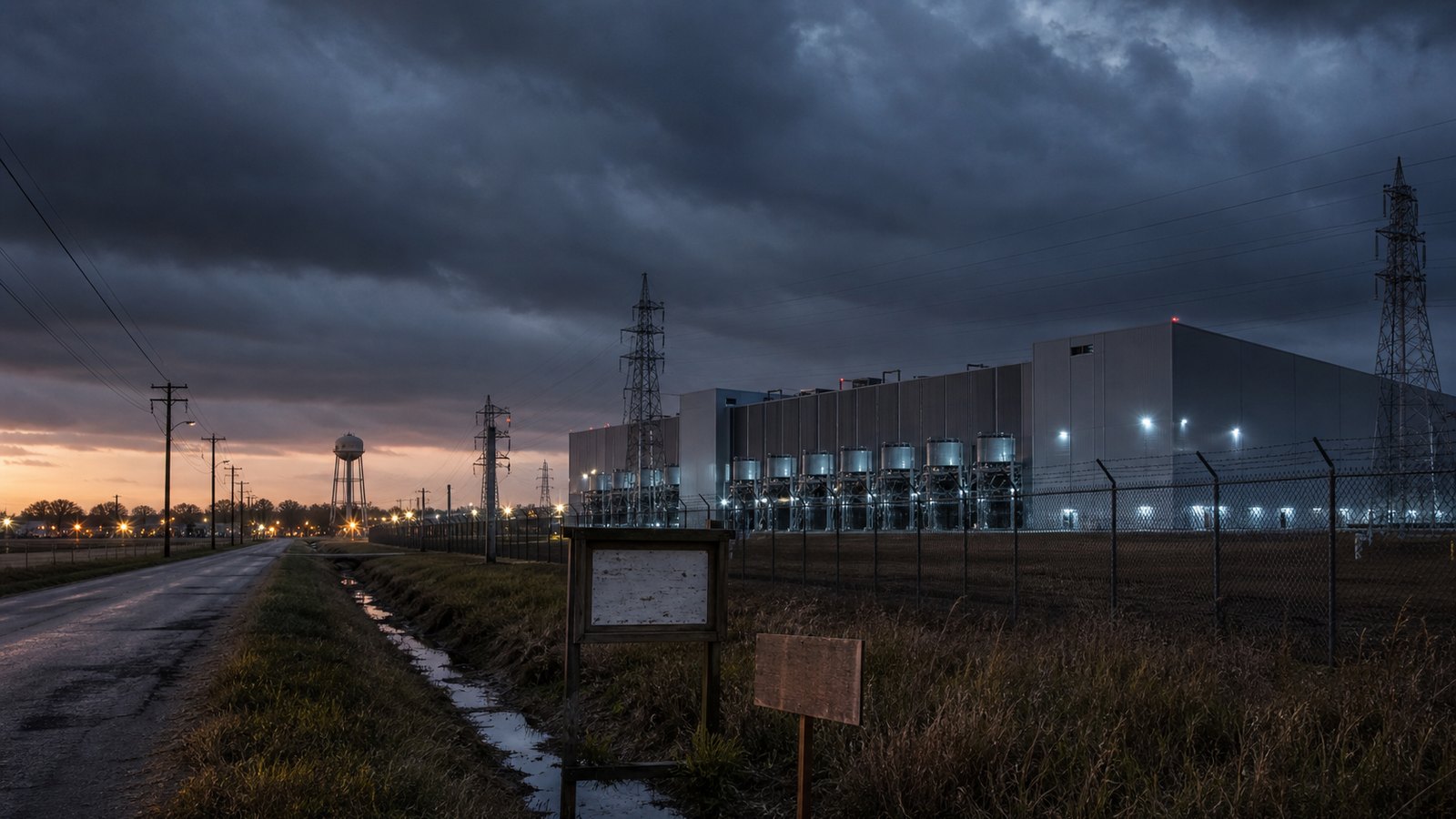
Pew's follow-up analysis found most new data-center development is headed toward rural areas. That geography is not accidental. Rural land can be cheaper, local governments can be easier to pressure with job promises, and transmission or water access can be packaged as a regional development plan.
The people who live beside the facility rarely receive the same upside as the firms operating it. A town may get construction traffic, hum, heat, water demand, emergency-service burden, and a changed landscape while the profit center, cloud contract, tax structure, and executive decision-making sit somewhere else.
The electricity math is not background noise
DOE says a Berkeley Lab report estimated that data centers consumed about 4.4 percent of total U.S. Electricity in 2023. The same report projects data centers could consume between 6.7 percent and 12 percent by 2028.
That is a national grid story, not a server-room footnote. AI boosters like to talk about intelligence, productivity, and inevitability. The physical version is substations, transformers, gas plants, transmission corridors, cooling systems, diesel backup generation, and fights over who pays when utilities build for massive new load.
Ratepayer risk is already on the White House desk
The administration knows the ratepayer problem exists. Trump's March 2026 ratepayer pledge directed federal officials to protect households and small businesses from paying for electricity investments that primarily benefit large-load customers.
That admission cuts through the happy talk. If data-center power demand were an uncomplicated public good, the White House would not need to promise that families and small businesses should not be stuck with the bill. The hard question is whether regulators will enforce that principle when the largest companies in the world arrive with urgent load requests.
Water is the second infrastructure bill
The data-center debate is not limited to electricity. Cooling technology, local climate, facility design, and water sourcing decide how much pressure a project puts on aquifers, rivers, municipal systems, and wastewater planning.
The public often learns about the water question late, after a project has already been framed as jobs and investment. A better process would put water demand, drought assumptions, discharge plans, and emergency restrictions in front of residents before tax incentives, zoning approvals, or utility commitments are treated as momentum.
People are not imagining the burden
Gallup found 71 percent of U.S. Adults would oppose an AI data center opening in their local area. Pew's polling also found Americans are more likely to see data centers as harmful than helpful for electricity supply, water supply, privacy, and the environment.
That is not irrational technophobia. It is a sign that people understand the exchange being offered. Their communities are asked to host infrastructure whose national-security, corporate, and military value is described in sweeping terms, while local benefits are often speculative and local costs are concrete.
The White House chose fast-track language
Trump's July 2025 executive order on data-center infrastructure directed agencies to accelerate federal permitting and remove barriers for qualifying projects. The order tied large-scale data centers to national security, economic prosperity, scientific leadership, and AI leadership.
That is the formal shift. Data centers are no longer just private real-estate or cloud projects. They are being treated as strategic infrastructure, which gives companies a stronger argument for speed, federal support, and political insulation from local objections.
AI policy is moving deeper into national security
In June 2026, the White House announced a directive on AI in the national security enterprise, describing frontier AI as a tool for military and intelligence missions. A separate June 2026 fact sheet announced advanced AI security measures requiring notice before frontier-model releases.
Taken together, those policies confirm that the AI race is not just about consumer chatbots or office automation. The federal government is building an AI governance lane that reaches military planning, intelligence work, model access, and infrastructure security.
Military cloud is part of the same infrastructure map
The Defense Department's Joint Warfighting Cloud Capability contract awarded Amazon, Google, Microsoft, and Oracle a multi-vendor cloud deal with a $9 billion ceiling. That contract is not the same as every private data center, but it shows how the largest commercial cloud firms already sit inside military computing.
When the same companies building civilian cloud capacity also supply military cloud infrastructure, the public-private line gets blurry. A warehouse of servers may be privately owned, locally permitted, and publicly subsidized while still sitting inside a broader national-security architecture.
The Israel claim needs precision
The viral version says U.S. AI infrastructure is being built to report back to Israel. The record does not support publishing that as fact.
The narrower record is still worth scrutiny. The House Armed Services Committee's FY2027 NDAA chairman's mark included Section 224, a United States-Israel Defense Technology Cooperation Initiative. The listed domains include artificial intelligence, machine learning, autonomous systems, cyber defense, data fusion, network integration, and related emerging technologies.
Defense cooperation is not civilian data-center ownership
Section 224 does not say Israel gets control of U.S. Civilian data centers. It does say the Defense Department should synchronize U.S.-Israel defense-technology cooperation, identify Israeli-origin or jointly developed technology for potential integration into U.S. Systems, and promote information-sharing mechanisms.
That distinction matters. Overstating the claim lets officials dismiss the whole critique. The real concern is less cartoonish and more durable: AI infrastructure is being built as a civilian-commercial boom while federal law and defense policy keep expanding the military and allied-security uses layered on top of it.
The surveillance history is not paranoia
The United States has a documented history of routing surveillance through communications infrastructure. NSA's Project MINARET targeted communications of U.S. Antiwar, civil-rights, and political figures. EFF's Room 641A litigation showed how AT&T infrastructure became central to warrantless internet-surveillance allegations after 9/11.
Those histories do not automatically turn every AI data center into a spy hub. They do destroy the naive argument that private infrastructure is harmless because it is private. When national-security agencies need scale, private networks and cloud systems become tempting pipes.
The protest problem is democratic, not technical
Residents have legitimate reasons to contest data centers: electricity demand, water draw, diesel backup, land use, tax breaks, noise, housing pressure during construction, local emergency planning, and the loss of control over what their community becomes.
A healthy government would treat that opposition as democracy. A captured one treats it as delay. A frightened one starts reaching for security language. Once a local land-use dispute is described as infrastructure sabotage or anti-technology extremism, the First Amendment shrinks around a server farm.
Our take: the race is real, but the sales pitch is crooked
China is a real competitor. AI is a real strategic technology. Data centers are real infrastructure. None of that requires surrendering local control, public utility discipline, water transparency, privacy protections, or basic skepticism toward tech companies asking for special treatment.
The crooked part is the bundle. Companies want cheap power, fast permits, water access, tax advantages, and political protection. Officials want AI dominance, military capability, and national-security leverage. Communities are asked to accept the burden because the words China and innovation are supposed to stop the questioning.
Our take: every approval should come with public conditions
No data-center approval should move without binding public conditions: full power-demand disclosure, water-use disclosure, backup-generation limits, heat and noise monitoring, ratepayer protection, emergency-service funding, tax-abatement clawbacks, and a ban on shifting grid-upgrade costs onto households.
Communities should also demand use restrictions where public money, public land, or public utility concessions are involved. If a project is sold as ordinary economic development, then residents deserve limits on later conversion into military, intelligence, biometric, or predictive-policing infrastructure without new public review.
Our take: local veto power is the missing safeguard
The data-center boom is being organized from the top down: federal policy, cloud giants, utilities, financiers, land brokers, and state economic-development offices. The people closest to the water pipe and power line enter late.
That order should be reversed. A town that will live with the noise, water draw, tax tradeoff, and utility consequences should have the power to say no. If the country needs AI infrastructure so badly, the burden should be negotiated honestly, not imposed through patriotic panic.
The fight is not anti-technology
The fight is over power in both senses of the word. Who gets electricity. Who pays for it. Who owns the compute. Who uses the models. Who watches the watchers. Who decides whether a rural road becomes a national-security corridor.
Calling every skeptic anti-AI is a dodge. The public is allowed to ask whether the AI boom is being built for human flourishing or for surveillance, war planning, corporate profit, and utility expansion. If the answer is human flourishing, the companies and agencies pushing the buildout can prove it in binding public terms.
Sources & records
Reviewed by Standards Review. Updated June 7, 2026.
- White House Data-Center Permitting Order
Used for the administration's July 2025 order accelerating federal permitting for large-scale data-center infrastructure and tying the buildout to national security and economic leadership.
- White House Advanced AI Innovation And Security Fact Sheet
Used for the June 2026 policy requiring notice before frontier-model releases and for the administration's AI leadership and security framing.
- White House AI In The National Security Enterprise Fact Sheet
Used for the national-security directive bringing frontier AI capabilities into military and intelligence missions.
- DOE Data Center Electricity Demand Report Release
Used for the Berkeley Lab estimate that data centers consumed 4.4 percent of U.S. Electricity in 2023 and could reach 6.7 to 12 percent by 2028.
- Pew Research On U.S. Data Centers
Used for the more than 4,000 existing U.S. Data centers and the broader geography of the buildout.
- Pew Research On Rural Data-Center Growth
Used for the more than 1,500 U.S. Projects in development and the shift toward rural siting.
- Pew Research On Public Views Of Data Centers
Used for national survey context on perceived effects on electricity supply, water supply, privacy, employment, and the environment.
- Gallup On Local Data-Center Opposition
Used for Gallup's finding that 71 percent of adults would oppose an AI data center opening in their local area.
- Defense Department JWCC Announcement
Used for the $9 billion Joint Warfighting Cloud Capability award to Amazon, Google, Microsoft, and Oracle.
- House Armed Services FY2027 NDAA Chairman's Mark
Used for Section 224's United States-Israel Defense Technology Cooperation Initiative and its domains including AI, machine learning, autonomous systems, cyber defense, data fusion, and network integration.
- EFF On Room 641A
Used for historical context on AT&T, NSA surveillance, and the public-private infrastructure lesson from warrantless internet surveillance litigation.
- NSA Historical Publication On Project MINARET
Used for historical context on domestic communications surveillance of U.S. Antiwar, civil-rights, and political figures.
- White House Ratepayer Protection Pledge
Used for the administration's own recognition that major electricity investments must not shift data-center costs onto household and small-business ratepayers.