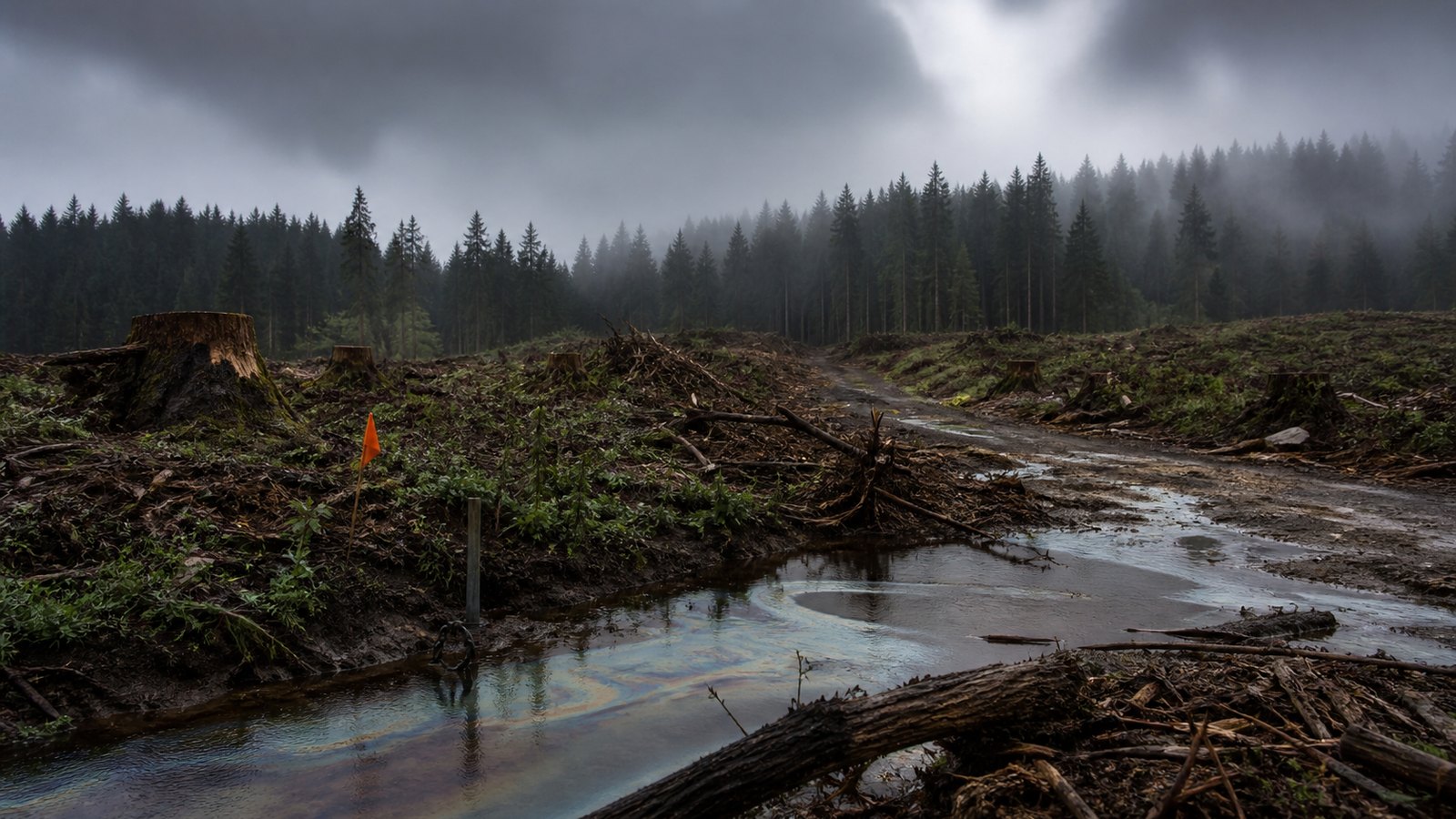
The environmental file is one pattern
The administration is not changing one rule in isolation. Across public lands, forests, drinking water, endangered-species enforcement, pesticide policy, and predator control, the same governing instinct keeps appearing: move faster for industry, narrow the habitat brake, treat chemical tools as normal infrastructure, and call the result efficiency.
The record does not need a secret memo saying the planet is expendable. The policy sequence is already visible. Timber expansion gets a White House order. Roadless protections move toward repeal. Habitat harm under the Endangered Species Act is targeted for narrowing. Glyphosate is elevated as a national-security supply concern. PFAS limits are cut back. Cyanide traps return to a case-by-case path on public lands.
Timber expansion came first
On March 1, 2025, Trump signed an executive order directing agencies to increase domestic timber production and reduce delay around federal timber projects. The White House fact sheet said the order would boost timber sales from public lands and push quicker approvals under the Endangered Species Act.
The operative order went further than a slogan. It directed Interior and Agriculture to set timber-sale targets for BLM and Forest Service lands, examine faster ESA consultation, consider categorical exclusions for timber work, and remove or revise agency actions that impose what the administration calls an undue burden on timber production.
USDA is building the timber pipeline
The policy did not stop at paperwork. In March 2026, USDA Rural Development announced $115.2 million in timber-processing loan guarantees across eight states and described the investments as part of the Trump administration's commitment to expand American timber production by 25%.
Sawmill capacity is not separate from forest policy. If the federal government funds and encourages more processing capacity while also accelerating timber approvals, the economic machinery starts demanding more logs. Forest policy then becomes a supply-chain program wearing a wildfire-management jacket.
Roadless protections are being pulled back
The Forest Service roadless rule has long restricted road construction and timber harvesting across inventoried roadless areas in national forests. USDA says its 2025 rescission would apply to nearly 45 million of the nearly 60 million inventoried roadless acres, with state-specific rules for Colorado and Idaho treated separately.
Roads are ecological commitments. Once roads enter a previously roadless forest, fragmentation, vehicle access, invasive-species pathways, fire-ignition risk, and future timber access all become easier. A roadless rollback is not just more management flexibility; it changes the physical map that wildlife and watersheds have to survive inside.
Conservation lost standing on BLM land
Interior also moved against the Biden-era BLM public lands rule that treated conservation as a formal use of public lands alongside development. AP reported on May 11, 2026 that Interior was canceling the rule as the administration sought to boost drilling, logging, mining, and grazing on taxpayer-owned land.
That cancellation matters in practice because BLM manages roughly a tenth of U.S. Land. When conservation is treated as secondary while grazing, drilling, timber, and mining keep privileged lanes, public land becomes a balance sheet for extraction rather than a living system with its own claim on federal protection.
Habitat law is being narrowed
FWS and NMFS proposed rescinding the Endangered Species Act regulatory definition of harm, including the language that covers habitat modification. The agencies argue the existing definition runs beyond the best reading of the statutory term take.
The practical danger is straightforward. Many species are not killed by a bullet, trap, or bulldozer blade aimed at their bodies. They disappear when nesting sites, host plants, migration corridors, wetlands, streams, and old-growth structure are degraded until survival fails. Narrowing habitat harm weakens one of the main ways the ESA reaches that slower form of destruction.
Insects live or die through habitat
Insect protection often arrives through habitat protection, not through a guard posted beside every bee, beetle, butterfly, or moth. If a pollinator depends on a host plant, a wet meadow, leaf litter, standing deadwood, flowering shrubs, or clean water, then destroying those conditions can be just as lethal as spraying the insect directly.
For that reason, logging, roadbuilding, herbicide use, and ESA habitat language belong in the same frame. The insect collapse question is not limited to insecticide labels. It is also about whether federal policy preserves the messy plant and soil systems that insects need before birds, fish, bats, reptiles, and mammals can feed on them.
Post-logging land can become chemical land
The accurate claim is not that every logged acre gets sprayed. The documented federal point is narrower and still serious: EPA says herbicides are used in forest management to prepare logged areas for replanting, and EPA's glyphosate page lists forests, conservation land, rangeland, aquatic areas, and wildlife-management areas among nonagricultural use settings.
That connects logging policy to chemical policy. If a forest is cut, burned, or otherwise disturbed, managers can treat broadleaf plants, shrubs, grasses, and woody growth as competition against selected trees. In a timber-first system, early-succession habitat becomes something to simplify, not something to let recover.
Roundup turns plant diversity into a target
Glyphosate does not have to be an insecticide to hurt insects. A broad-spectrum herbicide can remove food plants, cover, flowers, seed sources, and understory structure. Once those plants are gone, the food web above them gets quieter.
EPA's own biological-evaluation summary says glyphosate uses are likely to adversely affect certain listed species or critical habitats under ESA screening. USGS also reported glyphosate detections in 66 of 70 sampled U.S. Streams and rivers. Water and habitat exposure are part of the record, not a fringe fear.
Glyphosate got national-security protection
On February 18, 2026, the White House issued an order treating elemental phosphorus and glyphosate-based herbicides as national-defense supply concerns. The order said glyphosate-based herbicides are critical to agricultural productivity and delegated Defense Production Act authorities to USDA for supply protection.
That order did not settle the science fight. EPA had withdrawn its glyphosate interim decision after litigation, Bayer still faces Roundup cancer litigation, and ecological risk review remains tied to endangered-species consultation. The administration still chose to protect supply before the public fights over health, liability, and habitat were closed.
PFAS adds the water version
Forever chemicals bring the same pattern into drinking water. EPA's current PFAS page says that on May 18, 2026 the agency announced two proposed rules: one would let some drinking-water systems seek two more years, to 2031, to comply with PFOA and PFOS limits; the other would rescind drinking-water regulations for PFHxS, PFNA, GenX, and the hazard-index mixture involving those PFAS and PFBS.
The retreat follows a 2024 EPA rule that the agency said would reduce PFAS exposure for about 100 million people, prevent thousands of deaths, and reduce tens of thousands of serious illnesses. EPA's 2024 release linked PFAS exposure to cancers, liver and heart impacts, immune harm, and developmental damage to infants and children.
EPA capture is the corruption lane
The corruption claim should be reported with precision. The record we can publish is not a cash envelope. It is a regulator repeatedly translating health protection into cost relief, delayed compliance, narrower rules, and legal process arguments that benefit regulated industries.
EPA's PFAS rescission proposal explicitly discusses reduced expected compliance costs and reduced expected benefits. That is regulatory capture in plain clothes: the agency built to protect public health is measuring the value of retreat, even when the prior rule was designed around exposure reduction for tens of millions of people.
Cyanide returns to public-land review
Predator control adds the poison-trap branch of the same map. BLM's 2024 bulletin said the amended 2023 MOU prohibited M-44 devices that deliver sodium cyanide on all BLM-managed public lands. E&E News reported in May 2026 that BLM confirmed an April memorandum allowing those devices to be considered case by case.
M-44s are not abstract. BLM described them as spring-loaded devices that eject a lethal dose of cyanide into an animal's mouth, causing death within one to five minutes. The same bulletin referenced a 2017 Idaho incident where a teenager triggered one on BLM land, killing his dog and injuring him.
The burden moves onto living systems
Put the pieces together and the burden shifts in one direction. Forests absorb the roads. Insects absorb the habitat loss. Fish and amphibians absorb the runoff risk. Rural communities absorb the drinking-water delay. Public-land users absorb the poison-trap hazard. Wildlife absorbs the lethal control program.
Industry receives speed, certainty, production support, cost relief, and case-by-case discretion. The public receives promises that review will handle the risk later. By the time later arrives, the road is built, the herbicide is sprayed, the PFAS is in the water, or the cyanide device has already fired.
Doom is not a plan
Fatalism is understandable. It is also politically useful to the people doing the damage. If the planet is treated as already lost, then every rollback becomes background noise and every agency memo disappears into despair.
The better response is to name the machinery. Demand project-level herbicide maps before timber work begins. Fight the roadless rescission. Comment on PFAS rollback dockets. Push Canyon's Law. Track ESA harm changes. Make every agency choose between public health and industry convenience in daylight.
Sources & records
Reviewed by Standards Review. Updated May 22, 2026.
- White House Timber Production Fact Sheet
Used for the administration's timber-expansion framing, streamlined permitting language, and faster Endangered Species Act review language.
- White House Timber Production Executive Order
Used for the operative directives on timber targets, ESA consultation speed, categorical exclusions, and reduced permitting delays.
- USDA Timber Production Expansion Loan Release
Used for the $115.2 million timber-processing investment and USDA's 25 percent timber-production target language.
- USDA Roadless Rule Rescission Step
Used for the nearly 45 million-acre figure and the agency's explanation of the roadless-rule rescission process.
- AP On BLM Public Lands Rule Cancellation
Used for reporting that Interior canceled the Biden-era rule treating conservation as a formal use of BLM public lands.
- FWS/NMFS Proposed ESA Harm Rescission
Used for the proposal to rescind the regulatory definition of harm, including habitat-modification language.
- FWS 2025 ESA Regulation Revision Release
Used for the broader 2025 ESA regulatory-revision package, including threatened-species 4(d) changes.
- EPA Herbicides Overview
Used for EPA's statement that herbicides are used in forest management to prepare logged areas for replanting and for glyphosate mode-of-action context.
- White House Glyphosate Supply Order
Used for the February 2026 national-defense framing of glyphosate-based herbicide supply and delegated Defense Production Act authorities.
- EPA Glyphosate Page
Used for registered uses, including forests, aquatic areas, conservation land, rangeland, and wildlife-management areas.
- EPA Glyphosate Biological Evaluation Summary
Used for EPA's explanation that glyphosate uses are likely to adversely affect certain listed species or critical habitats under ESA screening.
- USGS Glyphosate In Streams And Rivers
Used for national stream and river detection data showing glyphosate appeared at least once in 66 of 70 sampled waterways.
- EPA PFAS Drinking Water Rule Page
Used for the May 18, 2026 PFAS proposals, the 2031 compliance option, and EPA's prior estimate that the 2024 rule would reduce exposure for about 100 million people.
- EPA Prepublication PFAS Rescission Proposal
Used for the proposal text rescinding regulatory determinations and drinking-water provisions for PFHxS, PFNA, GenX, and the hazard-index mixture.
- EPA 2024 PFAS Drinking Water Standard Release
Used for the 2024 EPA health framing, including cancer, liver, heart, immune, developmental, and infant/child health effects.
- BLM Information Bulletin IB 2024-024
Used for the prior BLM ban on M-44 sodium-cyanide devices and the agency's description of device mechanics and injury history.
- E&E News By POLITICO On M-44 Reversal
Used for BLM confirmation that the April 2026 memorandum allows M-44 devices to be considered case by case.
- Center For Biological Diversity Cyanide Bombs Campaign
Used for M-44 death totals and conservation-group response to the 2026 reversal.