The recall count is already ugly
As of Saturday, August 29, 2026, there is no honest single-number answer to how many food recalls America has. FDA, openFDA, and USDA FSIS count different things. FDA's public recall page is a notice board. OpenFDA is an enforcement-record database. FSIS runs a separate stream for meat, poultry, catfish, and egg products. Treating those systems as one clean scoreboard would mislead people.
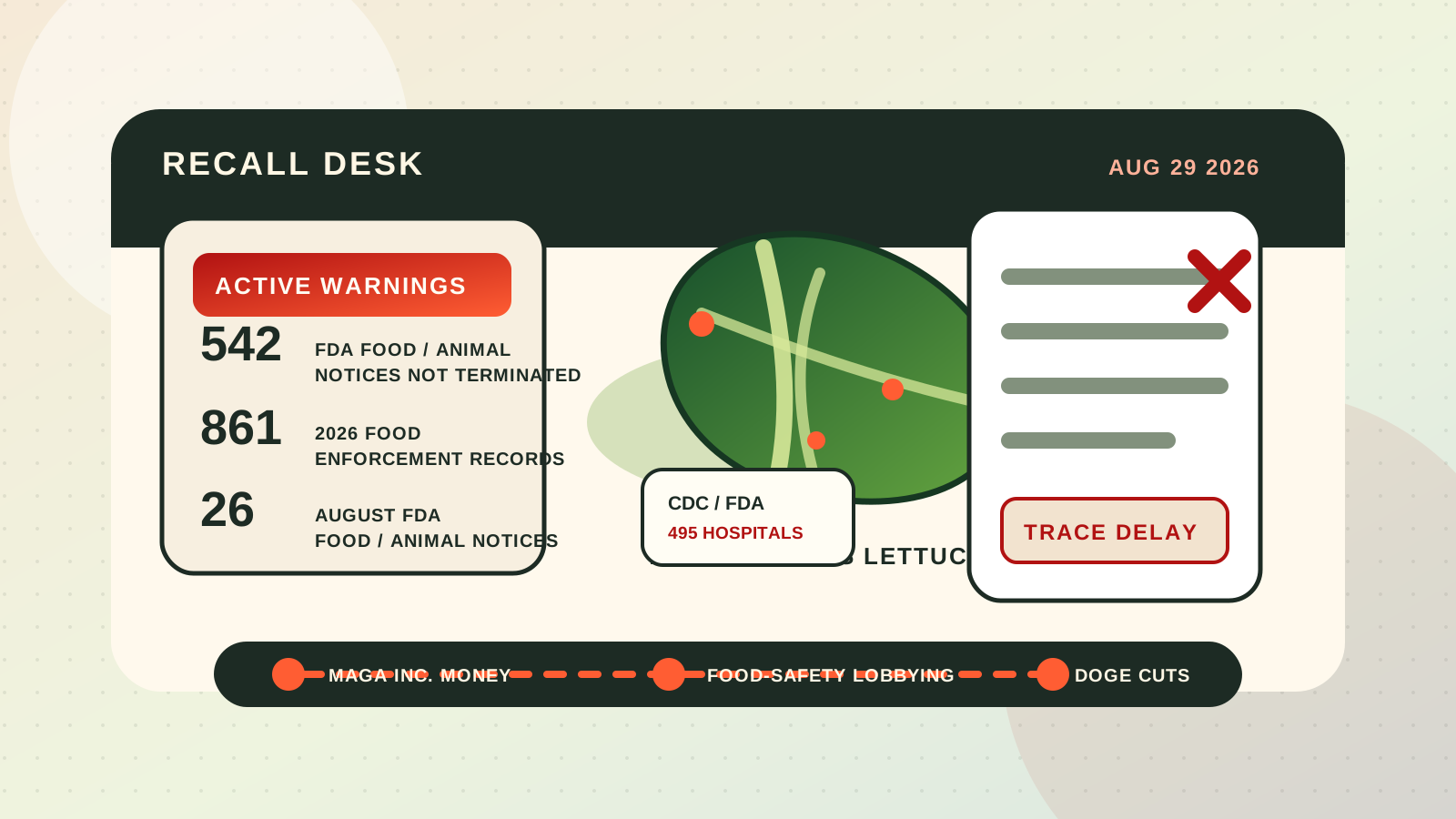
The FDA public workbook is still a useful pulse check. On August 29, it listed 1,036 public recall, market-withdrawal, and safety-alert rows in the agency's current window. WHYAMERICASUCKS.COM counted 777 rows tied to Food & Beverages, Animal & Veterinary, or Pet Food. Of those, 542 were not marked terminated.
For 2026 alone, that same FDA public workbook listed 152 food, beverage, animal, veterinary, or pet-food public notices. One hundred thirty-one were not marked terminated. In August 2026 alone, the FDA public workbook listed 26 food or animal-product notices, and all 26 were still not marked terminated when we checked.
OpenFDA gives a different angle. The official food enforcement API returned 861 food enforcement records with report dates from January 1 through August 29, 2026. Of those, 404 were marked ongoing. Across all report years in openFDA, 1,004 food enforcement records were marked ongoing. Enforcement records can split a broad recall into multiple rows for products, lots, or distributions, so those numbers should be read as regulatory workload, not a neat count of unique grocery-store crises.
The latest visible FDA public notices tell the story in miniature. The August list included raw pet food flagged for possible Salmonella or Listeria, feline milk replacers with nutrient problems, jalapeno ranch dressing with undeclared egg, donuts with undeclared milk, veggie chips with undeclared wheat, alfalfa sprouts flagged for Salmonella and shiga-toxin-producing E. Coli, canned dog food flagged for metal, bread flagged for metal, and Taylor Farms de Mexico lettuce flagged for possible Cyclospora contamination. That is a food system blinking red from every direction: pathogens, allergens, metal, mislabeling, and contaminated produce.
A record lettuce outbreak is still growing
The lettuce outbreak is not social-media guesswork. FDA and CDC say they are investigating a multistate Cyclospora outbreak linked to iceberg lettuce sourced from central Mexico and recalled by Taylor Farms de Mexico. On August 27, 2026, the agencies reported 11,458 illnesses in 20 states, 495 hospitalizations, and two deaths. The most recent illness onset listed by FDA was August 15.
CDC lists the outbreak as open. Its advisory says the recalled products should no longer be in stores or restaurants because the best-by dates have passed, but the human toll keeps being counted. CDC also notes a diagnostic trap: routine stool tests do not always screen for Cyclospora. People can have watery diarrhea, fatigue, loss of appetite, weight loss, cramping, bloating, gas, nausea, and symptoms lasting days to a month or longer without treatment.
FDA's timeline shows how messy the case became. On July 17, Taylor Farms de Mexico removed all iceberg lettuce sourced from central Mexico from the U.S. Market. The recall covered Walmart Marketside iceberg salad and shredded lettuce with best-if-used dates from July 18 through August 3, among other products. FDA said traceback data converged on lettuce tied to Taco Bell locations, and earlier interviews found 90 percent of interviewed Taco Bell patrons reported eating iceberg lettuce.
Then came the false-positive fight. FDA later said a product sample initially reported as positive for Cyclospora was a false positive. But FDA also said the correction did not change the epidemiological and traceback evidence supporting the recall. Translation into normal language without softening the stakes: one lab result fell away, but the outbreak investigation did not clear the lettuce supply chain.
The Associated Press put the national scale in context. CDC had reported roughly 29,000 confirmed or suspected Cyclospora cases in the United States during 2026 and 922 hospitalizations. The previous worst year, 2019, had about 4,700 illnesses. A fresh-produce illness that once registered as a bad year now looks like a national failure with salad bags attached.
The reassurance came before the climb
The allegation circulating online is direct: Trump took money from the lettuce outbreak and said the lettuce was fine. The verified public record does not support that exact sentence. We found no verified public record showing Donald Trump personally received money tied to the outbreak, and we found no verified public record showing Trump personally told the public the lettuce was fine.
The verified record points somewhere slightly different and still extremely serious. The public reassurance came from Trump's health secretary, Robert F. Kennedy Jr. ABC News reported that Kennedy said on July 21, 2026, that the outbreak was under control. At that point, the public federal count was far smaller than the August 27 total. By late August, the same outbreak had reached 11,458 cases, 495 hospitalizations, and two deaths.
Kennedy's statement may have reflected what officials believed at the time: they said they had identified a source and companies had implemented a recall. But public-health reassurance has a clock attached. If officials say an outbreak is under control and the case count later explodes, the public deserves a clear explanation of what officials knew, what changed, and whether staffing, lab capacity, traceability gaps, or political pressure slowed the response.
Sen. Elizabeth Warren's office went further, saying the administration's response raised questions about corruption and influence peddling. Her July 2026 inquiry said a senior HHS official minimized the outbreak as a couple cases of diarrhea while thousands were sick. That phrasing is Warren's allegation and framing, not a line we independently verified from a released HHS recording. The health consequences are not disputed in the same way: CDC and FDA's public numbers show a massive outbreak.
The supplier had a Washington lane
Taylor Farms is not just a salad company in the record. It is a politically active, regulation-facing food giant with money in Trump-aligned politics and lobbyists working on food-safety rules. WIRED reported that Taylor Farms donated more than $3.6 million to conservative groups between 2020 and 2025, including $1 million to MAGA Inc., the Trump-centric super PAC. WIRED also reported more than $2 million in Taylor Farms donations to conservative groups in 2025 alone and more than $810,000 spent lobbying on food-safety regulation after the company hired Sidley Austin in early 2025.
Congressional Democrats have seized on the timing. Warren's office said Taylor Fresh Foods donated $1 million to MAGA Inc. After the administration delayed the Food Safety Modernization Act traceability rule. Her inquiry also said Taylor Fresh Foods later gave $100,000 to another Trump-aligned PAC before the administration moved to end mandatory Cyclospora reporting. House Oversight Democrats demanded records from Taylor Farms over whether donations and White House connections interfered with FDA's investigation.
Sen. Richard Blumenthal's letter to Taylor Farms described a reported White House call after FDA identified Taylor-linked lettuce as a potential outbreak source. The letter says Taylor Farms contacted the White House seeking delay of a recall announcement, that the White House brought FDA officials onto the call, and that former FDA commissioner Scott Gottlieb said he knew of no precedent for that kind of White House intervention in FDA recall management. Those are allegations and reported facts in a congressional inquiry. They deserve documents, calendars, call logs, and emails.
The company and HHS deny improper influence. WIRED quoted HHS saying nothing influences its decisions except science and the safety of the American people. Taylor Farms has disputed responsibility for the outbreak and criticized pieces of the federal response. The public should not have to choose between corporate press releases and senatorial suspicion. Release the call records. Release the communications. Release the traceback documents that can be legally released. Let the timeline stand in daylight.
The money trail stops short of a smoking gun
A super PAC donation is not the same thing as cash handed to Trump personally. That distinction has to stay in the article because accuracy is part of the weapon. The record we have supports a narrower claim: Taylor Fresh Foods and Taylor Farms were politically aligned with Trump-world, gave large sums to conservative and Trump-aligned committees, hired food-safety lobbyists, and gained unusual White House proximity during a live outbreak dispute.
The narrower claim is bad enough. MAGA Inc. Exists to help Trump and his political operation. A million dollars to that vehicle is political power. Lobbying on food-safety regulation is not a hobby. A White House call during a recall fight is not normal customer service. Each piece has a legal explanation. Together, they create the exact credibility problem corruption rules are supposed to prevent.
The public does not need a cartoon bribe to smell rot. In a functioning food-safety system, a giant supplier under outbreak scrutiny would not have a political money trail running straight into the president's support network while the same administration delays traceability rules and cuts the agencies expected to investigate the supplier. Formal legality is not the same as public trust.
Traceability was delayed before consumers got sick
Food outbreaks move faster than paperwork, which is why the Food Safety Modernization Act traceability rule exists. FDA says the rule is designed to create additional recordkeeping for certain high-risk foods so contaminated products can be identified and removed faster, reducing illnesses and deaths. Leafy greens are exactly the kind of food where speed counts because one contaminated distribution chain can become a multistate outbreak before shoppers know anything happened.
The original compliance date was January 20, 2026. FDA then moved the practical deadline to July 20, 2028, a 30-month delay. FDA's page says the agency proposed the extension and that a continuing appropriations law directed FDA not to enforce the rule before July 20, 2028. The delay landed before the Taylor Farms outbreak became a national scandal.
Warren's inquiry tied that delay to the political-money timeline: the administration announced the traceability delay in March 2025, and Taylor Fresh Foods donated $1 million to MAGA Inc. Days later, according to her office and campaign-finance reporting. A time sequence alone is not a court finding. But a time sequence this ugly earns subpoenas, not shrugs.
The traceability delay also exposes the false economy of deregulation. Companies save money when paperwork is delayed. The public pays when investigators have to reconstruct the chain after illness spreads. A rule that helps find contaminated food faster is not red tape in the middle of an outbreak. It is the map out of the ditch.
DOGE cut the safety net underneath the outbreak
The food-safety system was already strained when the outbreak hit. HHS announced in March 2025 that restructuring aligned with President Trump's DOGE workforce optimization order would reduce about 10,000 full-time employees across HHS, and that retirements, buyouts, and layoffs would shrink the department from about 82,000 to about 62,000 employees. HHS said it would do more with less and said critical services would continue.
The official HHS fact sheet said FDA would decrease by about 3,500 full-time employees and CDC by about 2,400. HHS asserted that food reviewers, inspectors, and drug reviewers would not be affected. That claim should be tested against what actually happens when the people around inspectors, labs, travel, data, and outbreak teams are cut.
FoodNavigator, using Office of Personnel Management data, reported deeper agency losses across the broader food-safety ecosystem: FDA lost 3,859 employees in 2025 and 473 more in 2026; CDC cut 2,889 jobs; USDA's Food Safety and Inspection Service cut 913 full-time employees; and the Food and Nutrition Service cut 564. The same analysis said HHS lost 17,406 employees and USDA lost 22,253 since the start of 2025.
Elon Musk's DOGE project was sold as efficiency. Food safety is a brutal place to test that slogan. Inspectors do not appear fully trained from a spreadsheet. Laboratory systems do not self-heal. Outbreak investigators need data, travel support, purchasing, administrative staff, supervisors, and institutional memory. Cut the people who make the work possible and officials can still say inspectors were spared while the system underneath them caves in.
Support staff are inspection capacity
ProPublica reported that foreign food inspections fell to historic lows after Trump-era cuts, with current and former FDA officials blaming deep staffing losses. Its reporting found that inspections began falling after 65 percent of the staff who coordinated travel and budgets left or were fired. By the end of July 2025, foreign food inspections were nearly 30 percent below comparable prior periods, with March down nearly half.
That detail wrecks the administration's favorite dodge. If the inspector keeps a badge but loses the people who arrange travel, budgets, scheduling, reimbursements, data support, and lab coordination, the inspection still disappears. A food-safety system can be hollowed out without firing every person whose title says inspector.
Imports are central here because FDA says the recalled Taylor Farms de Mexico lettuce was sourced from central Mexico. No one has to demonize Mexican farms to recognize the obvious: cross-border food supply chains require fast, funded, competent federal oversight. Slashing the office machinery that gets inspectors into the field is reckless when Americans are eating produce that moves through complex international networks.
The lab network took a hit
Guardian and Reuters reporting found that FDA suspended a quality-control program for the Food Emergency Response Network after staff cuts. That network links roughly 170 labs that test food for pathogens and contaminants. The report said the suspended proficiency-testing work included planned checks around Cyclospora in spinach and glyphosate in barley.
A lab network is not glamorous. It is the quiet architecture behind safe food. Proficiency testing is how labs prove they can find the thing they say they can find. Suspend that quality-control system during a period of rising outbreak pressure and the country is gambling with the very evidence it needs to move fast.
The lettuce outbreak included a false-positive controversy, which made public trust even shakier. False positives can happen in science. The answer is not to weaken the lab ecosystem. The answer is to fund it so testing, confirmation, communication, and correction happen quickly and transparently. A government that cuts lab support and then asks people to trust late clarifications has created its own credibility crisis.
Parasite surveillance was narrowed
CBS News reported that CDC's food-parasite tracking capacity had been cut hard, including a drop from 11 scientists tracking food parasites to three. CBS also reported that FoodNet, a foodborne illness surveillance system, narrowed required reporting after July 1, 2025, with pathogens beyond Salmonella and E. Coli becoming optional and Cyclospora no longer tracked by that system in the same way.
The Taylor Farms outbreak is a parasite outbreak. Cutting parasite expertise before a record Cyclospora year is the kind of governing failure people feel in their stomachs before they see it in a budget table. You cannot starve surveillance and then claim surprise when outbreaks outrun public understanding.
HHS and Kennedy have pushed back on criticism, arguing that core surveillance remained and that some reductions removed redundancy. The real-world test is harsh: if public systems become slower, thinner, less complete, or more dependent on voluntary reporting during a national outbreak, the redundancy talk starts to sound like branding for absence.
Recalls are warnings after exposure
A recall is not prevention. A recall often means the product has already moved through farms, processors, warehouses, trucks, restaurants, shelves, kitchens, and bodies. The system is supposed to reduce the time between contamination, detection, traceback, removal, and public warning. Every hour lost belongs to someone else's stomach, hospital bill, missed work, or funeral.
The August recall list shows how much burden has been pushed downstream onto consumers. People are expected to monitor FDA pages, decode lot numbers, know which agency covers which food, understand whether a notice is terminated, keep track of best-by dates, and still somehow trust that deregulated, consolidated supply chains are safe. The average family is not built to be a full-time food-safety analyst at dinner.
Food companies love the language of consumer choice until the danger arrives. Then the public is told to check labels, throw food away, call doctors, watch symptoms, and wait for updates. The corporation gets scale. The public gets homework.
Our take
America is running food safety like a cleanup crew after the spill, then acting shocked when people stop trusting the mop. The Trump administration delayed traceability, cut staffing, weakened the supporting machinery around inspections and labs, and relied on reassurance while a record Cyclospora outbreak kept growing. Taylor Farms and its parent operation had money in Trump-aligned politics and lobbyists on food safety while their lettuce supply chain sat inside the biggest outbreak of its kind.
The personal-payout claim is not supported by the public record we found. Fine. The legalistic denial should not end the conversation. A donor does not need to slip cash into a president's hand for the system to be corrupt. Influence often looks like access, timing, delays, friendly regulators, former officials on the payroll, and agencies too understaffed to push back hard.
If a company can sell salad nationwide, give to the president's political machine, lobby on the exact safety rules that would make outbreaks easier to trace, reach the White House during an outbreak dispute, and still face a federal apparatus weakened by DOGE cuts, public anger is rational. The scandal is not that people are suspicious. The scandal is that the system keeps earning suspicion.
Food safety cannot be vibes, loyalty, deregulation, or donor access. It has to be boring, funded, fast, independent, and annoying to powerful companies. Rebuild the labs. Rebuild the inspection support staff. Restore strong parasite surveillance. Enforce traceability now instead of 2028. Publish the White House call records. Make suppliers prove safety before people get sick. Anything less is a government choosing cheaper paperwork over human bodies.
Sources & records
Reviewed by Standards Review. Updated August 29, 2026.
- FDA Recalls, Market Withdrawals, And Safety Alerts
Official FDA public-notice page. FDA warns that not every recall has a press release or appears on the page.
- FDA Public Recall Workbook
Downloadable FDA workbook used for the August 29, 2026 public-notice counts by product type, date, and termination status.
- openFDA Food Enforcement API
Official FDA enforcement API used for 2026 food enforcement record counts through August 29, 2026.
- FDA Taylor Farms Cyclospora Investigation
Official outbreak investigation page with the August 27, 2026 case count, recall timeline, traceback notes, and false-positive clarification.
- CDC Cyclospora Outbreak Advisory
CDC advisory with outbreak fast facts, symptom information, and the warning that routine stool tests do not always screen for Cyclospora.
- Associated Press On Outbreak Expansion
Independent report on the August 2026 expansion to 20 states, the Taylor Farms focus, and the broader 2026 Cyclospora surge.
- ABC News On RFK Jr. Statement
Public account of Robert F. Kennedy Jr. Saying the outbreak was under control on July 21, 2026, when federal counts were far below the later August total.
- HHS DOGE Restructuring Announcement
Official HHS announcement tying the restructuring to President Trump's DOGE workforce optimization order and describing the 82,000-to-62,000 department-wide shrinkage.
- HHS DOGE Restructuring Fact Sheet
Official HHS fact sheet listing about 3,500 FDA cuts and about 2,400 CDC cuts while claiming critical food and drug safety functions would continue.
- FoodNavigator On FDA, CDC, USDA Staffing Cuts
OPM-based staffing analysis and expert warnings about inspection, laboratory, outbreak, and support-staff losses across food-safety agencies.
- ProPublica On Foreign Food Inspections
Data reporting on foreign food inspections falling to historic lows after staffing cuts, including travel and budget coordination losses.
- Guardian And Reuters On FDA Lab Quality Checks
Report on FDA suspending proficiency testing for a 170-lab food-emergency network after Human Food Program staffing cuts.
- CBS News On Food-Safety Cuts
Reporting on FDA and CDC staffing cuts, reduced food-parasite tracking capacity, FoodNet changes, and agency defenses of the cuts.
- WIRED On Taylor Farms Spending And Lobbying
Campaign-finance and lobbying reporting on Taylor Farms, MAGA Inc., conservative PACs, CEO donations, and Sidley Austin food-safety lobbying.
- Sen. Warren Inquiry On Taylor Farms And HHS
Congressional inquiry on Taylor Farms political spending, White House contact allegations, traceability-rule delay, and HHS outbreak messaging.
- House Oversight Democrats Taylor Farms Inquiry
Oversight inquiry seeking records from Taylor Farms about outbreak response, political spending, lobbying, and White House access.
- FDA Food Traceability Rule Page
Official FDA page explaining the traceability rule, the original January 20, 2026 compliance date, and the new July 20, 2028 non-enforcement date.