The spill is small enough to dismiss and large enough to learn from
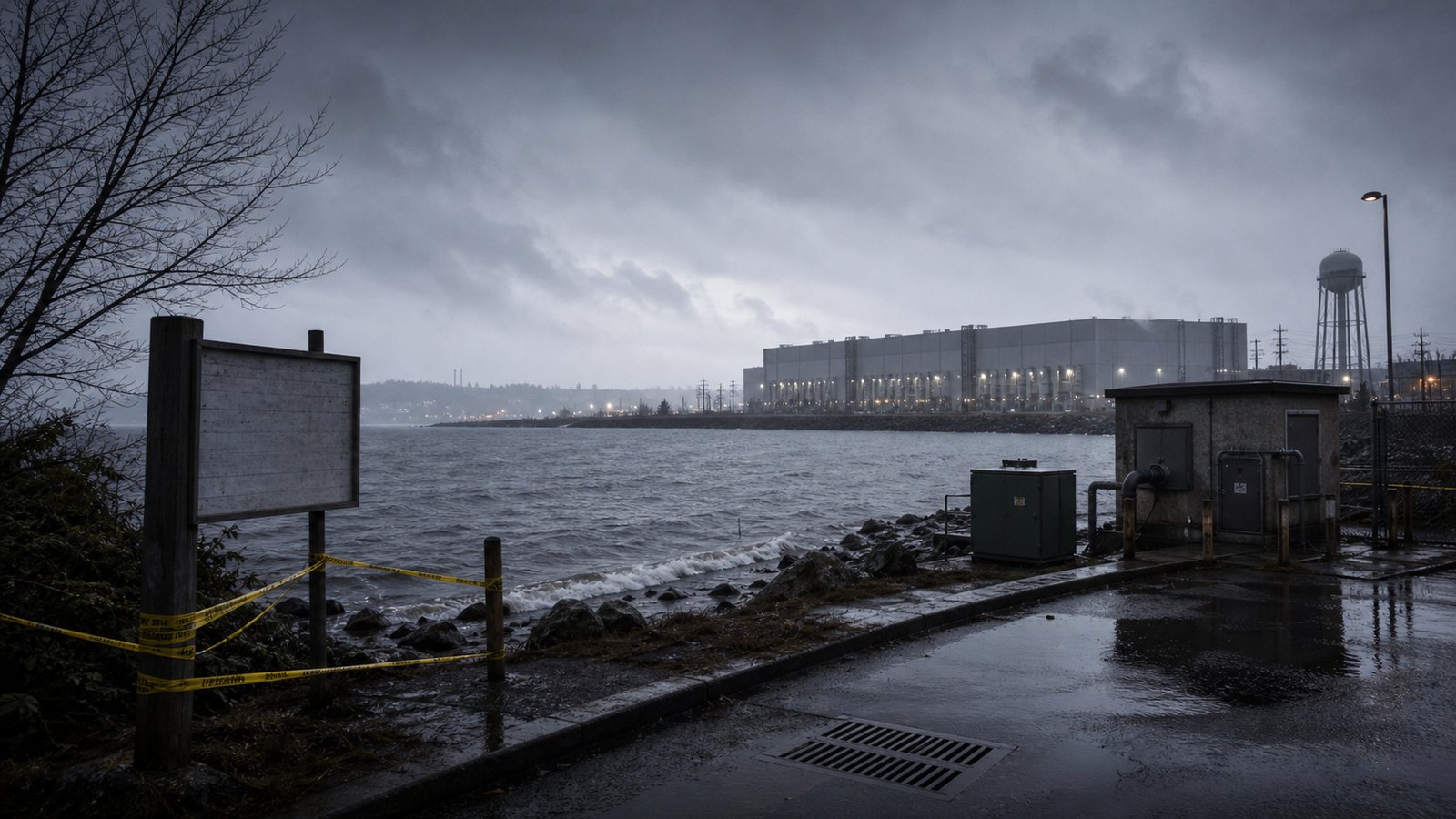
About 13,000 gallons of untreated wastewater went into Puget Sound near West Seattle, according to KIRO 7's report on King County Wastewater Treatment Division statements. The reported window was short: crews discovered the problem around 10 a.m. On June 17, 2026, and stopped the leak by 11:30 a.m.
A number like 13,000 gallons can sound modest beside the giant figures people hear during hurricanes, pipeline failures, and refinery disasters. A shoreline does not experience it as a spreadsheet. Public Health - Seattle & King County told people and pets to stay out of Cormorant Cove water until 11:30 a.m. On June 24, while nearby advisories for Constellation Park and Charles Richey Sr. Viewpoint were lifted sooner.
The West Seattle failure
The county told KIRO 7 that crews were replacing a flow-control gate near the 63rd Avenue Pump Station when another gate, used to isolate upstream flow, was found leaking. Untreated wastewater then went into Puget Sound through the pump station's offshore emergency outfall.
The public-health response was immediate because sewage contamination is not an aesthetic problem. It can carry pathogens, force beach advisories, interrupt recreation, endanger pets, and require sampling before the water can be treated as safe again. The visible event is a sign on the beach. The real event is a public system losing control of waste that residents pay to keep out of the water.
The repair context makes the failure sharper
King County was already working in the same infrastructure corridor. Its Alki standby generator project covers the Alki Wet Weather Treatment Station and the 63rd Ave Pump Station, with the county describing the project as a way to provide reliable power, prevent wastewater overflows into Puget Sound and nearby waters, and protect water quality.
That context should make the public more serious, not less. A system can be under improvement and still fail. A community can be told a project protects the water while the work itself, adjacent equipment, or aging infrastructure exposes another weak link. The lesson is not that public infrastructure upgrades are bad. The lesson is that water infrastructure is unforgiving, and the cost of a weak valve, a power problem, or a rushed plan shows up in the water.
Now look south to St. Helens
St. Helens, Oregon is not West Seattle. The sewer systems are different, the geography is different, and the Puget Sound spill was a King County event. The connection is broader and more useful: both places sit inside the same regional fight over whether public water, wastewater, power, and cleanup systems are ready for the industrial projects being pushed onto riverfronts and shorelines.
In St. Helens, the records now point to a former industrial site owned by Upland Data Center LLC. Oregon Building Codes Division vessel records list Upland Data Center LLC at 1645 Railroad Ave, Saint Helens, Oregon, with RestorCap Development LLC as the responsible party and five permits per site. City planning records from October 2024 said the Armstrong World Industries site at that address had been purchased by Upland Data Center LLC and that the city had preliminary discussions about a data center there.
The site is not a blank green field
Oregon DEQ describes the former Armstrong World Industries site as a 175-acre property along Scappoose Bay, about one mile south of St. Helens. The facility made fiberboard products from 1929 until it closed in 2018. DEQ says several decades of industrial wastewater discharge into nearby wetlands and Scappoose Bay left contamination in soil and sediment.
The pollutants named by DEQ include dioxins and furans, metals such as arsenic and mercury, and polycyclic aromatic hydrocarbons. DEQ also says contaminants in in-water sediment can build up in fish, clams, and crayfish, creating health risks for people who eat them and harm to fish and wildlife. EPA's site profile lists the Armstrong World Industries address as 1645 Railroad Avenue and identifies it as a state-led cleanup, not a site on the National Priorities List.
The cleanup record is central
DEQ says the upland cleanup was completed in 2019 through removal of highly contaminated hot spots, a gravel and asphalt cap, and institutional controls. The harder current record is the lowland and in-water cleanup: DEQ says an interim removal action will remove about 52,000 cubic yards of heavily contaminated soil, sediment, and wood waste across a 10-acre portion of the lowland.
Construction for that removal work is expected from spring 2026 through 2028, according to DEQ. The agency also says the property is now owned by Upland Data Center LLC and remains vacant pending future redevelopment. That is the part residents should underline. A data-center conversation at this site begins inside an environmental cleanup conversation, not after it.
The sewer record is already in the file
The City of St. Helens wastewater capacity amendment for Pump Station 7 should be read beside the data-center record. The amendment says the city wants to design upgrades to PS 7 as part of a wastewater collection capacity project, with current firm capacity of 310 gallons per minute and a wastewater master plan recommendation to raise capacity to 1,400 gallons per minute.
The same document says the existing pump station is located at 58369 Old Portland Road, within an easement on a parcel owned by Upland Data Center LLC. It also says the replacement station would include new submersible sewage pumps, a new wet well, stormwater handling, power upgrades, and a permanent standby generator capable of operating the facility.
A pump station is never just a pump station
A pump station is a public-health machine. When it works, people barely notice it. When it fails, wastewater reaches a beach, a creek, a river, a bay, or a basement before anyone has time to debate terminology. That is the lesson of the Puget Sound spill, and it is the lens St. Helens should use before any data-center project is allowed to become a done deal through momentum.
The St. Helens document describes bigger capacity, backup power, chemical treatment planning for hydrogen sulfide if needed, stormwater management, easements, geotechnical work, and floodplain design standards. Those are not decorative engineering details. They are the public cost map around growth.
Data centers are physical industry
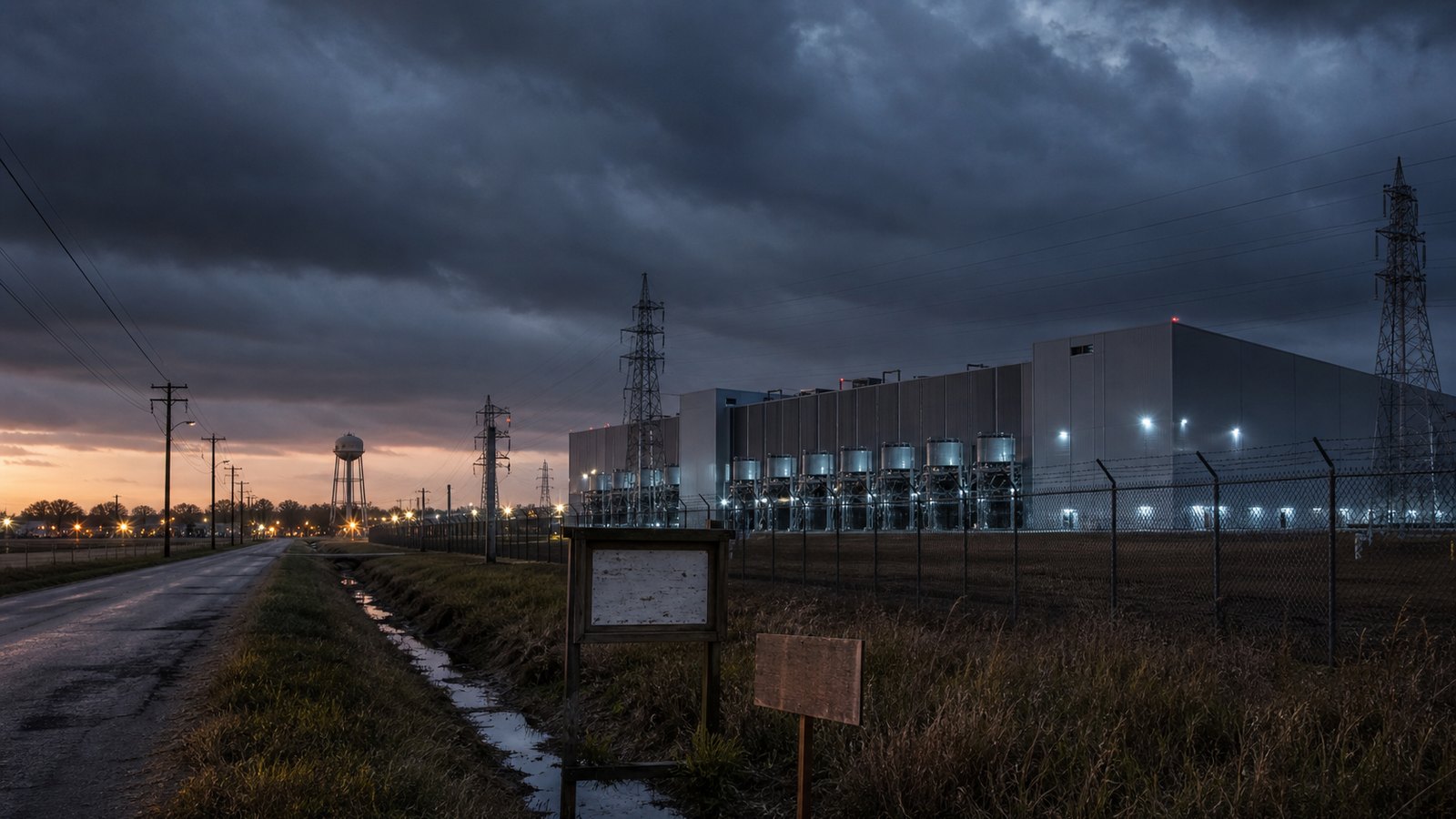
The public sales pitch often treats a data center as if it were weightless: cloud computing, AI, digital economy, modern jobs, tax base. The physical version is land, power, water, cooling, wastewater, stormwater, backup generation, substations, transformers, roads, security fencing, emergency planning, and long-term municipal leverage.
A server building may look cleaner than a refinery stack. It can still create demands that land on the same pipes, wires, permits, ratepayers, public works staff, and waterways. The question for St. Helens is not whether data centers are modern. The question is whether the community sees the whole bill before officials celebrate the headline investment number.
Oregon already knows the water data is weak
Oregon's Data Centers and Water dialogue draft says there is currently no aggregate data on data-center water use in Oregon. It also says facility-level industrial water use is often treated as business information and rolled into broader city water or wastewater reporting.
That is a serious problem for any town being asked to host a large facility. Residents cannot evaluate a proposed industrial user if the central numbers arrive late, stay confidential, or get described only in corporate sustainability language. Water demand, consumptive loss, cooling method, wastewater discharge, chemical treatment, drought priority, and emergency curtailment rules should come before applause.
Cooling choices change the public burden
The Oregon water draft explains that data centers can use closed-loop cooling, which generally uses less water but costs more, or open-loop and evaporative cooling, which generally use more water and can be cheaper. It also notes that cooling water is typically discharged to municipal wastewater treatment plants and can pick up residues from anti-corrosion chemicals, metals, or cooling infrastructure.
That makes the St. Helens question extremely concrete. What cooling method is planned? Will potable city water be used? Will groundwater be used? Will recycled water be used? How much will be consumed rather than returned? What wastewater characteristics will enter the municipal system? What happens during drought, heat, wildfire smoke, power outage, or pump-station failure?
The power question is tied to water
Oregon's Data Center Advisory Committee says the state is experiencing unprecedented demand from large-scale energy users including data centers and artificial intelligence. The committee's official charge includes siting criteria, ratepayer protection, natural-resource protection, and protecting limited water resources.
Power and water cannot be separated here. Cooling technology depends on power. Pump stations need power. Backup generators create noise and emissions. Grid upgrades can land on ratepayers if regulators are weak. OPB reported that Oregon regulators moved under the POWER Act to make PGE data-center customers and other large industrial users pay more for electricity access, after concerns that data-center growth was shifting costs onto ordinary customers.
St. Helens should demand the full operating plan
Before any local official treats the Upland project as inevitable, residents should get a full operating plan in plain English. That plan should include projected megawatts, projected annual water withdrawal, peak-day water demand, cooling technology, wastewater discharge volume, wastewater chemistry, backup generator fuel, expected generator runtime, stormwater design, floodplain analysis, and emergency curtailment rules.
The city should also publish who pays for each piece of supporting infrastructure. If Pump Station 7, roads, power, stormwater facilities, or emergency services need upgrades, the public deserves a line-by-line answer on developer contributions, ratepayer exposure, bond exposure, tax-abatement terms, and clawbacks if promised jobs or revenue fail to appear.
The cleanup should not become a bargaining chip
A contaminated industrial site can create a political trap. Officials can imply that any redevelopment is automatically good because the site is ugly, vacant, polluted, or economically underused. That can be true in part and still dangerous in practice.
Cleanup should be mandatory because contamination threatens people, fish, wildlife, wetlands, and the river system. Redevelopment should be evaluated on its own terms. A company should not receive a lighter review on water, sewer, power, or ratepayer impacts because a previous generation of industry already damaged the shoreline.
The local government test is transparency
A responsible St. Helens process would put all major documents in one public portal: land-use filings, water studies, wastewater capacity analyses, power-service agreements, environmental assessments, cleanup schedules, easements, tax agreements, development agreements, and public comments.
The city should also hold meetings at times working people can attend, with remote access, plain-language summaries, and enough time for independent review. Data-center projects move fast because speed benefits developers. Public review moves slower because residents have jobs, children, bills, and no paid permitting team. A fair process accounts for that imbalance.
Questions for Upland and RestorCap
Upland Data Center LLC and RestorCap Development LLC should answer direct public questions before the project advances further. What is the planned campus size? Who is the end user or tenant? What is the expected power draw? What cooling system is planned? What water source is planned? What wastewater discharge is expected? What hazardous materials will be stored onsite? What diesel or gas backup generation is planned?
They should also disclose whether public incentives are being sought, whether any utility upgrades are needed, whether construction depends on the DEQ cleanup timeline, and whether the company will sign binding agreements to pay for infrastructure burdens tied to the project. If a company wants to occupy a riverfront community, it can meet the community at the level of detail required to protect that community.
Questions for city and state officials
St. Helens and Oregon officials should answer a different set of questions. What wastewater capacity is already committed? How much future capacity is reserved for housing and local businesses? What happens if industrial demand grows faster than projected? What enforcement mechanism stops residents from subsidizing a private facility through utility rates or public debt?
Officials should also explain how the Armstrong cleanup, Scappoose Bay fish advisory, wetlands, floodplain considerations, pump-station design, and Columbia River system fit together. The public should not have to assemble that map from scattered PDFs while developers and consultants know the whole plan.
Our take: stop calling this inevitable
The data-center boom is being sold across the country as destiny. AI needs compute, compute needs buildings, buildings need land, and therefore communities are supposed to nod along. That framing is corporate pressure dressed up as technological realism.
Nothing about a data center at a former contaminated industrial waterfront should be treated as automatic. If the project can meet strict water, wastewater, cleanup, power, noise, ratepayer, and public-health conditions, the company can prove it. If it cannot, St. Helens should be willing to say no without being accused of opposing the future.
Our take: the Puget Sound spill is the warning
The West Seattle spill shows how quickly infrastructure failure leaves the abstract world and enters public life. One leaking gate, one pump-station emergency outfall, one morning of uncontrolled wastewater, and people are told to keep themselves and their pets out of the water.
A community considering a major industrial load should keep that image in mind. The public is not paranoid for asking what happens if the pump station loses power, if a gate fails, if a backup generator fails, if stormwater overwhelms the site, if cleanup runs long, if water demand exceeds forecasts, or if the company changes tenants after approvals are secured.
Our take: no blank check on a riverfront
St. Helens should not offer a blank check to any data-center developer, especially on a former industrial waterfront with contamination, wetland, wastewater, and power records already in play. Public officials should treat the site as sensitive, not convenient.
The minimum standard should be simple: no hidden water demand, no hidden wastewater burden, no hidden power subsidy, no weakened cleanup, no vague tenant, no secret utility deal, no ratepayer bailout, no public money without clawbacks, and no final approval until residents can see the full infrastructure burden in one place.
A better standard for St. Helens
A better process would make the developer pay for independent third-party review selected by the city, not by the company. It would publish water and wastewater modeling. It would require enforceable drought curtailment. It would require company-funded emergency-response capacity. It would put cleanup milestones ahead of redevelopment milestones. It would make public subsidies contingent on verified jobs, local hiring, and no cost-shifting to households.
It would also give residents a real veto point. Public participation is not a comment box at the end of a nearly finished deal. Public participation means people can change the outcome before officials become emotionally, politically, or financially invested in approval.
The warning is already in the water
Puget Sound did not need a gigantic disaster to remind the region what wastewater failure looks like. Thirteen thousand gallons was enough to close water, trigger sampling, and put public-health warnings on the shoreline.
St. Helens has the chance to learn before the failure. The former Armstrong site sits inside a record of industrial wastewater, contaminated sediment, fish and wildlife risk, cleanup, pump-station capacity planning, and statewide concern about data-center water and power demand. If officials approve a data-center buildout there without binding protections, they will not be able to say nobody warned them.
Sources & records
Reviewed by Standards Review. Updated June 22, 2026.
- KIRO 7 On Puget Sound Wastewater Release
Used for the 13,000-gallon estimate, June 17 leak timing, 63rd Avenue Pump Station location, offshore emergency outfall, and beach-advisory status.
- KIRO 7 Follow-Up On Reopened Beaches
Used for the follow-up status of Constellation Park, Charles Richey Sr. Viewpoint, and Cormorant Cove after water-quality sampling.
- West Seattle Blog Follow-Up
Used for local follow-up on the stay-out-of-water zone, temporary repairs, and public-health warning area.
- King County Alki Standby Generator Project
Used for the county's reliability project at the Alki Wet Weather Treatment Station and 63rd Ave Pump Station, including public statements about preventing overflows into Puget Sound.
- Oregon Building Codes Division Vessel Site
Used for the Upland Data Center LLC site listing, 1645 Railroad Ave address, RestorCap Development LLC responsible-party listing, and five vessel permits.
- Oregon DEQ Former Armstrong Cleanup Fact Sheet
Used for the 175-acre site description, Upland Data Center LLC ownership, contamination history, 52,000-cubic-yard lowland cleanup, fish and wildlife risk language, and 2026-2028 construction window.
- EPA Armstrong World Industries Site Profile
Used for the EPA site profile at 1645 Railroad Avenue, state-led cleanup status, and EPA ID ORD093476109.
- St. Helens Planning Department Activity Report
Used for the October 2024 city planning report saying the Armstrong site was purchased by Upland Data Center LLC and that the city had preliminary data-center discussions.
- St. Helens Pump Station 7 Amendment
Used for Pump Station 7 capacity planning, Upland-owned parcel language, standby generator planning, stormwater handling, and 60-percent design scope.
- Oregon Data Centers And Water Dialogue Draft
Used for Oregon's data-center water transparency gap, water and wastewater planning concerns, cooling-water discussion, and examples of large data-center water demand.
- Oregon Data Center Advisory Committee
Used for the state's description of unprecedented large-load demand, ratepayer affordability concerns, and committee work on energy, land use, and water.
- Oregon Data Center Advisory Committee Charge
Used for the official charge language on siting criteria, ratepayer protection, water protection, and environmental impacts from data-center growth.
- OPB On Oregon Data Center Power Costs
Used for Oregon's ratepayer and large-load power-cost context, including PGE data-center rate changes under the POWER Act.